
Alienation, Contempt, and the Lost Art of Paideia
A Philosophical Reflection on Modern Civility

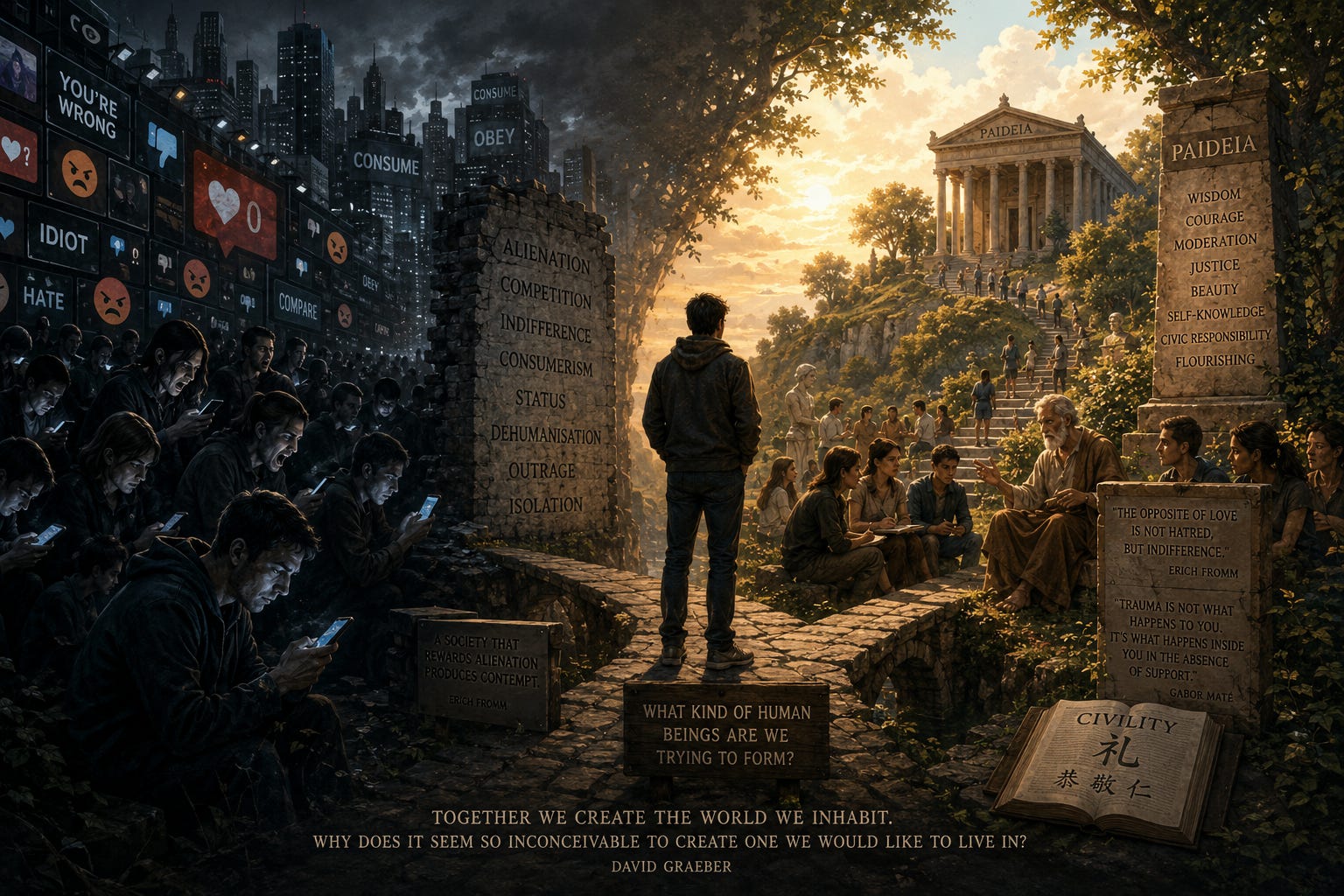
1. A society that rewards alienation
Erich Fromm would probably claim that the increasing rudeness in modern life is not just a matter of declining manners, but a sign of a deeper psychological and cultural problem: alienation. In works such as The Sane Society and The Art of Loving, Fromm describes modern societies as systems that progressively detach individuals from their authentic human needs of connection, meaning and relatedness, while encouraging them to view themselves and others in increasingly objectified terms.
Within such a framework, people become competitors, consumers, brands or ideological positions. The living presence of another person is reduced to a function, a label or a threat. Once this reduction takes place, contempt requires very little effort. The other person is no longer encountered as a fully human subject, but as an abstract object within a system of comparison.
Fromm distinguishes between biophilia (a love of life, growth, and connection) and necrophilia, not in a literal sense, but as a psychological orientation towards what is mechanical, controlled, and emotionally deadened. In his view, a culture that increasingly values categorisation over encounter, control over openness, and performance over presence will inevitably become harsher.
One of Fromm’s most striking observations is that the opposite of love is not hatred, but indifference. Hatred still recognises the other person as real, but indifference erases that recognition altogether. In this sense, casual cruelty is often not born of deep enmity, but of a diminished sense of presence. The stranger becomes an abstraction, and abstractions are easy to dismiss, ridicule, or attack.
2. Hurt people transmit hurt.
Gabor Maté offers a complementary perspective from a more contemporary psychological standpoint. For Maté, many forms of destructive behaviour originate in unresolved trauma, unmet emotional needs and chronic stress. He argues that modern societies frequently produce conditions of anxiety, isolation and overwork, while offering limited spaces for genuine emotional integration.
In this view, trauma is not only what happens to people, but also what remains unprocessed within them when support is absent. This emotional residue does not disappear; it circulates.
From this perspective, the rise of online hostility is not surprising. Social media becomes a channel through which accumulated frustration is rapidly discharged into the public sphere. Rather than being processed through reflection, relationships, or understanding, emotional pain is expressed impulsively.
Maté also highlights a key tension between attachment and authenticity. People often suppress parts of themselves to remain socially acceptable or to feel a sense of belonging. Over time, this suppression can generate resentment, emotional numbness and, eventually, indirect forms of aggression, which are often directed at strangers who bear no personal responsibility for the original injury.
3. Social media as an amplifier
Although neither Fromm nor Maté developed a theory of social media, their frameworks converge in their explanation of its effects.
Fromm would probably argue that social media intensifies the commodification of human interaction. Individuals are encouraged to perform, curate themselves and compete for attention. Others become either audiences or rivals within an economy of visibility. In such conditions, judgment, mockery and dehumanisation become easier.
Maté would emphasise the emotional dimension, arguing that these platforms are designed to exploit emotional intensity. Outrage, contempt and indignation are not accidental by-products, but rather highly rewarded forms of engagement. The system does not create hostility out of thin air; it amplifies and monetises existing tendencies.
In both cases, technology is not separate from human psychology. It interacts with it, magnifies it and redistributes it.
4. An older question: Paideia
Yet these concerns are not new. A similar anxiety about character formation lies at the heart of the ancient Greek concept of ‘paideia’.
For the Greeks, paideia (παιδεία) referred not simply to education, but to the comprehensive development of a person’s intellect, character, judgement, taste and civic responsibility. It was the process by which a person became fully formed within the life of the city-state.
Although the root pais (child) suggests development, paideia was not merely pedagogical. It was existential. Societies were judged by the quality of the individuals they produced.
The Greek ideal was that democracy and civic life could only function with cultivated citizens, those people capable of moderation, courage, wisdom and self-restraint. Intelligence alone was not enough. Without moral formation, political life would degenerate into manipulation, faction and desire.
However, this ideal had one key limitation. In practice, paideia was largely restricted to a privileged minority of free-born male citizens who had sufficient wealth and leisure time. The term ‘scholē’, from which ‘school’ derives, originally meant ‘leisure’. Cultivation required time, and time required material security. Consequently, those engaged in constant labour were effectively excluded from the highest forms of cultural and philosophical development.
Thus, paideia embodies an unresolved tension: a universal ideal of human excellence realised within an exclusive social structure.
5. Expanding and Transforming Paideia
Even in ancient times, this exclusivity was challenged. The Cynics rejected social status as irrelevant to virtue. The Stoics went further, insisting that rational and moral capacity is distributed universally. A slave could be wiser than a king. In this sense, figures such as Epictetus embodied a radical democratisation of moral development.
Christianity furthered this transformation. While it did not abolish hierarchy, it shifted the focus of human worth. The decisive question was no longer one of educational or civic status, but of spiritual standing: not ‘How cultivated are you?’, but ‘How do you stand before God?’
This shift elevated people who would have been marginalised in classical paideia, such as fishermen, artisans, widows, ascetics and the poor. Humility, charity, forgiveness and faithfulness became central virtues. The concept of moral worth became universal.
However, Christianity did not simply replace paideia; it transformed it. Early Christian thinkers such as Augustine absorbed and transformed classical education, merging intellectual cultivation with spiritual formation. The result was a long and complex synthesis in which the formation of the soul became a universal calling, at least in principle.
6. Modernity and New Elites
The explicit aristocratic structure of antiquity has largely disappeared in modern societies. However, new forms of stratification have emerged, based not on birth, but on education, cultural capital, cognitive style and professional status.
People are often evaluated according to the following criteria:
educational credentials
professional success
economic productivity
cultural sophistication
ideological alignment
social visibility and influence
The vocabulary may have changed, but a familiar division persists between the ‘cultivated’ and the ‘uncultivated’, the ‘informed’ and the ‘ignorant’, and the ‘enlightened’ and the ‘backward’.
Thinkers such as Alasdair MacIntyre, Pierre Bourdieu and Christopher Lasch have all analysed how modern systems of knowledge, education and professionalism can generate new forms of social distinction and moral fragmentation in different ways.
What is significant here is not only institutional inequality, but also the emotional tone it produces. Contempt becomes easier when difference is interpreted as inferiority rather than variation within the human condition.
7. Civility, Confucius, and the Fragility of Social Space
A similar concern appears in the Confucian concept of li, the ritual propriety or cultivated civility. In this tradition, civility is not just about following rules of etiquette, but about shaping inner dispositions through repeated respectful action. Behaviour and character are mutually formative.
From this perspective, small acts of disrespect are never merely trivial. They accumulate. They shape expectations, emotional reflexes and social atmospheres.
This helps to explain a contemporary paradox: societies may become less overtly violent, yet people may feel more abrasive, suspicious and emotionally unstable in their everyday interactions. The erosion is subtle but cumulative.
8. Graeber and the Limits of Imagination
David Graeber’s critique adds another dimension to the discussion. He observes that modern societies collectively produce and reproduce systems that few individuals would consciously design. In his view, capitalism is not merely an economic structure, but an emergent reality sustained by countless interactions, assumptions and habits.
Once established, such systems become self-reinforcing. They shape what is perceived as realistic or possible. Alternatives are not necessarily refuted but rather rendered difficult to imagine.
Therefore, Graeber’s provocation is not only economic, but also imaginative: why does it feel easier to accept the world as it is than to envision it otherwise?
This connects directly to the earlier themes. If a society normalises constant evaluation, rewards visibility over presence, turns attention into currency and frames identity through comparison, then the texture of everyday life shifts. Interaction becomes subtly competitive, performative and evaluative. Contempt is no longer exceptional; it becomes just another social tone.
9. A Shared Question: What Forms the Human Being?
Drawing on Fromm, Maté, the Greek tradition of paideia, Confucian civility and Graeber’s critique of systemic imagination, a shared question emerges: What kind of social world produces what kind of human beings?
Fromm would frame this in terms of alienation and human need.
Maté would frame it in terms of trauma and emotional integration.
The Greeks would consider it in terms of character formation and civic virtue.
Graeber would frame it in terms of systems that shape what is thinkable.
However, beneath these differences lies a convergence: human beings are not simply individuals acting within a neutral environment. They are shaped, psychologically, morally and imaginatively, by the structures they inhabit.
10. Conclusion: The Return of Paideia
In this context, concern about increasing social unpleasantness is not just a complaint about manners. It is a question of formation. If societies do not consciously cultivate ‘paideia’ in the broad sense of character, judgement, empathy and civic responsibility, then other forces will take over this role: markets, algorithms, attention economies and the informal ethics of competition and comparison.
The Greeks, despite their limitations, understood something fundamental: civility and virtue do not arise automatically. They must be cultivated. Christianity extended this insight to everyone. Modern egalitarianism made this a universal principle. The unresolved question today is whether this universal aspiration can be sustained within systems that increasingly reward fragmentation, comparison and emotional reactivity.
In other words, if we no longer deliberately develop our character, what kind of character will our world develop for us?
Here is a transliteration of what a famous man once said:
The hour has ripened.
The gate stands open.
Being itself—groundless ground, ever-present—
shines near, nearer than nearness,
not arriving from distant realms,
but abiding in the silent core
of the one who stands before you.
Turn.
Step away from the worn and circling roads.
What you seek has never been absent;
it waits within you.
Trust the Good.
Incline your whole being toward it.
There is no divide.
Enter.
The hidden seed of what you are
lies close—
closer than breath,
closer than the pulse of your own becoming.