
Practising Panentheism
Discovering its Heart

The curious paradox of Western religion—particularly in its more fundamentalist expressions—is that while it often claims to centre on Christ, in practice it revolves around having a personal God, not a deep imitation of Christ’s way of being. It’s less about living in communion with Christ's teachings—compassion, nonviolence, humility—and more about asserting loyalty to a deity with defined traits, preferences, and rules.
This raises a familiar but profound question: how does one follow a God? Especially when that God is conceived not as a living presence in one's ethical life but as a distant authority demanding submission.
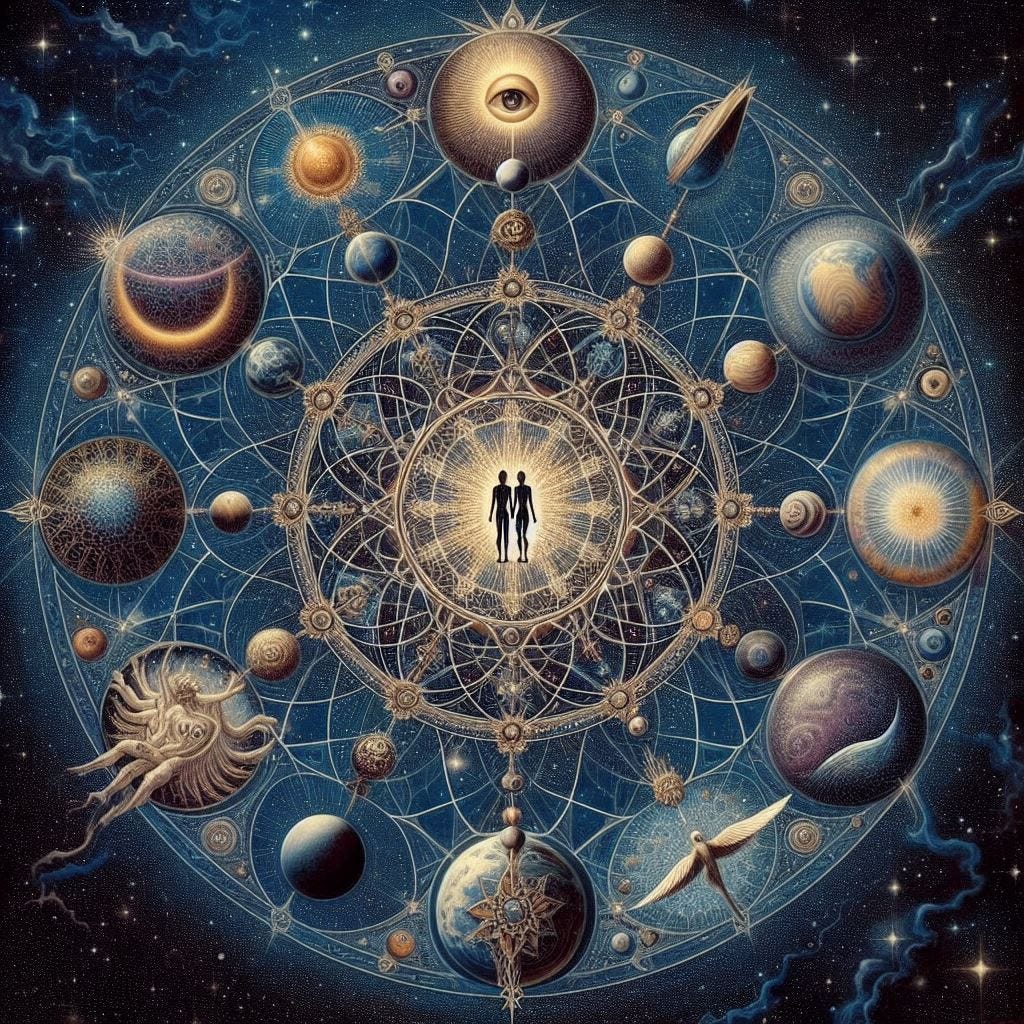
My answer begins with recognising who we are. We are prodigal children of the cosmos, estranged not from a parental figure, but from the deeper unity that underpins all life—a unity rooted in consciousness itself. The sacred is not external to us but woven into the very fabric of our awareness. To remember this is to begin returning home.
It ultimately doesn’t matter what name we give to the divine—Elohim, Yahweh, Allah, Hayyi Rabbi, Waheguru, Mbombo, Unkulunkulu, Mpungu, Atum, Marduk, Ptah. These anthropomorphic names and mythologies serve as symbolic gateways, pointing not to a being in the sky but to the transcendent mystery underlying existence: the ungraspable source, both immanent and beyond.
In this sense, "faith" takes on a deeper meaning. In traditions like Hinduism and Taoism, it is not faith in a being, but faithfulness to a Way. In Advaita Vedanta, faith involves recognising that the individual self (Atman) is not separate from Brahman, the universal consciousness. Liberation (moksha) comes not through obedience, but through realisation. And this awakening brings not only freedom from illusion but also an ethical sensibility rooted in empathy and interconnection. Conscious evolution moves us toward greater compassion, cooperation, and awareness of our shared destiny.
Taoism offers a similar insight: to live in harmony with the Tao—the unnameable, generative principle behind all things—is to cultivate simplicity, humility, and non-contention. The Taoist ethic is not grounded in laws or commandments, but in attentiveness to the patterns of nature. Wu wei, or effortless action, means allowing things to unfold without coercion, trusting in the rhythms of life rather than dominating them. From this emerges a quiet morality: not imposed but observed; not preached but practised.
Panentheism, too, affirms the sacredness of all life—not by worshipping a deity separate from creation, but by recognising that the divine is both within the world and beyond it. This worldview encourages reverence, ecological consciousness, and ethical responsibility. It frames morality not as external command but as arising from a deep relationship with each other, with the earth, with the mystery that sustains all things.
Such a vision cultivates humility. We acknowledge that the ultimate reality transcends our understanding, and this leads to restraint, to wonder, to ethical awareness without fanaticism. It resonates with the Taoist principle of non-forcing and the Hindu emphasis on non-attachment and discipline. Yet, unlike rigid religious systems, panentheism remains a philosophical orientation—it values tradition but also questions it. It honours myth without becoming a prisoner of literalism.
This is the tension: while religious traditions carry profound insights, fundamentalism often traps them in dogma. Panentheism, by contrast, invites us to see beyond the surface—to recognise that the divine is not a sovereign ruler issuing decrees, but the living unity in which all things participate. Our task is not blind obedience, but conscious alignment with reality, with love, with the deep structure of being itself.
Mysticism and Panentheism
Mysticism and panentheism are natural companions. Where panentheism provides a philosophical framework—the idea that the divine is both immanent (in the world) and transcendent (beyond it)—mysticism is the lived experience of that truth. Because mysticism cuts across traditions—Sufi Islam, Christian contemplative prayer, Kabbalah, Advaita Vedanta, Taoist inner alchemy—it often reveals common ground. Panentheism supports this interfaith resonance. Since the divine permeates all existence, it’s natural that mystics in diverse cultures might touch similar truths.
Mysticism is rooted in the intuition or experience that the divine is not merely an object of belief but something that can be known, or at least deeply felt. In panentheism, since the divine is present in all things, including the self, mystical experiences are not about escaping the world to find God, but about seeing the world as God-filled. Nature, people, silence, even suffering—any of these can become thresholds to the sacred.
Mystics like Meister Eckhart (Christian), Ibn ‘Arabi (Sufi), or Ramanuja (Vedantic Hindu) speak of encountering the divine within the soul and through the world. In panentheism, this makes sense: God is not confined to heaven or a temple but lives through all things and thus can be encountered in any moment of profound stillness or love.
Unlike pantheism, which equates God with the universe, panentheism maintains that God is more than the universe. Mysticism reflects this, too. The mystic may feel union with God (as in the Sufi’s fanā, or the Christian’s unio mystica), but this union does not collapse all distinctions. There's a paradox: we are not God, but we are not other than God, either. We are within the divine, and the divine within us, yet the mystery always remains greater than our grasp.
Mystical experiences are often ethically transformative. The sense of unity with all life leads naturally to compassion, humility, and a deepened moral awareness. This fits the panentheistic view that the divine presence infuses all beings, making every encounter potentially sacred. The mystic doesn't love because they were told to, but because they see—feel—no real separation.
Symbolism, Metaphor, and the Limits of Language
Both mysticism and panentheism acknowledge the limits of dogmatic or propositional theology. Mystics often speak in paradox, poetry, or symbol, because the ultimate cannot be captured by rational categories. Likewise, panentheism resists literalism—it invites multiple metaphors for the divine, knowing all are partial.
For example, mystics may say, "God is a flame," "a lover," "the ground of being," or "a hidden silence." Panentheism supports this openness: since God is both in and beyond the world, there is no final word, only approximations.
Mysticism usually involves spiritual practice—contemplation, prayer, meditation, chanting, fasting—disciplines that cultivate receptivity to the divine presence. In panentheistic traditions, these practices are not about placating a deity but about tuning in to what is already present.
This emphasis on presence over petition is key: you don’t call God down; you awaken to what is already here.
Mysticism is the heart of panentheism. Where panentheism says, "God is in all things and all things in God," mysticism responds, "And I have felt it." It is the experiential thread that makes panentheism more than just an abstract philosophy—it is what turns belief into being.
"The One in All" (translated by Coleman Barks)
I tried to find Him on the Christian cross,
but He was not there;
I went to the Temple of the Hindus and to the old pagodas,
but I could not find a trace of Him anywhere.
I searched on the mountains and in the valleys
but neither in the heights nor in the depths was I able to find Him.
I went to the Kaaba in Mecca,
but He was not there either.
I questioned the scholars and philosophers,
but He was beyond their understanding.
Then I looked into my heart,
and it was there where He dwelled that I saw Him;
He was nowhere else to be found.
(most commonly attributed to Jalal al-Din Rumi, the 13th-century Persian Sufi mystic and poet. However, this particular version—especially in the phrasing you may have seen—is not a direct translation of any single poem in Rumi's original Persian texts)
We’ll aid, Rob.